SphericalBRM vs Shopify B2B for NetSuite businesses
If NetSuite already runs your pricing, promotions, stock and tax, Shopify B2B means rebuilding each of them in a second system and paying a connector to keep the two in step.
Jump to a section8 sections
Many B2B companies that run on NetSuite reach a point where they ask whether ordering should move to Shopify B2B. This comparison looks at the areas that matter most to distributors, wholesalers and manufacturers, and at what each option costs to own.
Bottom line
For a B2B business already running on NetSuite, SphericalBRM is usually the better fit. It runs inside NetSuite, so pricing, promotions, discounts, stock, subsidiaries and tax all work the way they already do there. Moving to Shopify B2B means rebuilding each of those in Shopify, then paying a connector to keep two systems in step:
- Customer-specific pricing requires Shopify Plus. Plus starts at $2,300 a month. Lower plans allow 3 catalogs, assigned to markets rather than to a single company (Shopify).
- Promotions and discounts get set up twice. Shopify's checkout uses its own discount engine, not your NetSuite promotions.
- Stock is a copy. Buyers see Shopify's count, refreshed by the connector, not NetSuite's own figures.
- Each subsidiary needs its own connector account and store. Oracle's connector links one store per account, and Oracle recommends a separate account for each subsidiary that orders sync to (Oracle).
- Tax is calculated in Shopify, then mapped back to NetSuite tax codes.
- Subscriptions alone run about $38,900–$39,800 a year for Shopify Plus, the connector and a credit-limit app, before implementation.
How each works
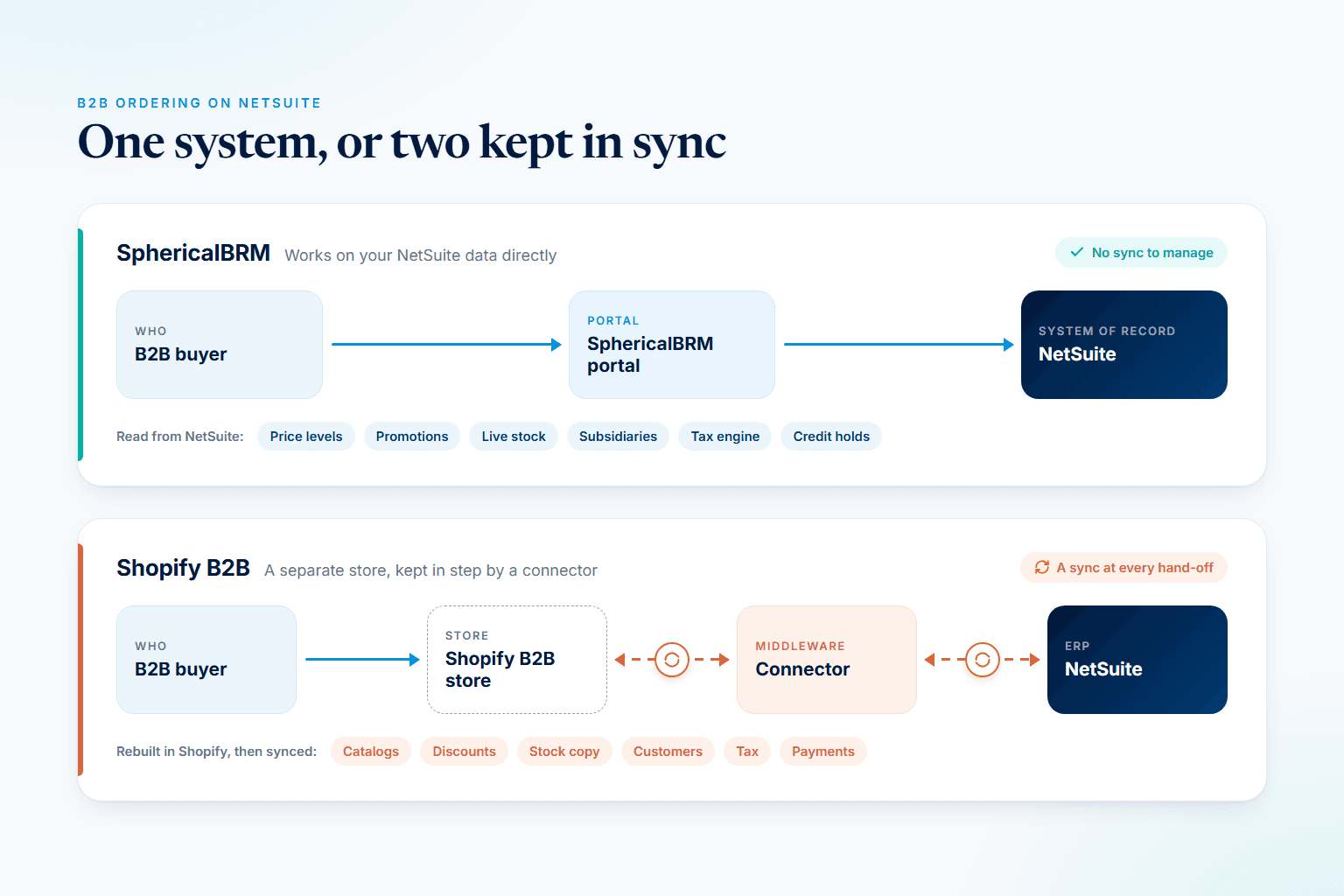
The SphericalBRM portal works on your NetSuite data directly:
Shopify B2B is a separate store, and a connector keeps its data in step with NetSuite:
In the second setup, every hand-off is a point where data can lag or fail to sync: a price change, a new customer, a stock update or a payment.
Six areas where Shopify B2B adds work
In each of the six areas that matter most to a B2B seller, SphericalBRM uses what NetSuite already does. Shopify B2B has to rebuild it and then keep it in sync.
Customer-specific pricing
- Moving to Shopify B2B: Prices must be rebuilt as Shopify catalogs. Basic to Advanced allow 3 catalogs, assigned to B2B markets, and none can be assigned to a single company, so per-customer pricing requires Plus (Shopify). When a company location has several catalogs that include the same product, the lowest price applies (Shopify).
- Staying on SphericalBRM: Uses each customer's NetSuite price level and the customer-specific item prices on their record, with nothing to rebuild or sync.
Promotions
- Moving to Shopify B2B: Shopify's checkout uses its own discount engine, so NetSuite promotions and coupon codes must be recreated as Shopify discounts. A discount open to all customers also applies to B2B buyers unless you limit it to specific markets (Shopify).
- Staying on SphericalBRM: NetSuite applies its own promotions and coupon codes to each order, automatically or by code, just as it does for an order entered in NetSuite.
Discounts
- Moving to Shopify B2B: Volume breaks are set up again in each catalog (Shopify). More detailed discount rules need a discount app built on Shopify Functions, either from the App Store or custom-built (Shopify).
- Staying on SphericalBRM: NetSuite quantity schedules reprice a line as the quantity changes. Order and line discounts use your NetSuite discount items.
Live stock
- Moving to Shopify B2B: Buyers see Shopify's inventory count, updated by the connector. Celigo's B2B template lists no inventory flow, and its flows run on a schedule (Celigo). Between syncs, buyers can order stock that has already been sold through another channel.
- Staying on SphericalBRM: When the buyer orders, available, on-hand, committed and on-order quantities for each location are read from NetSuite.
Multiple subsidiaries
- Moving to Shopify B2B: Oracle's connector links one store per connector account (Oracle), and when orders sync to more than one subsidiary, Oracle recommends a separate connector account for each (Oracle). Every new subsidiary means another store, another connector account and more catalogs.
- Staying on SphericalBRM: One portal covers every subsidiary, each with its own catalog, branding, payment and tax settings. Adding a subsidiary is a configuration change.
Taxes
- Moving to Shopify B2B: Tax is calculated in Shopify, and each company location's exemptions have to be entered again there (Shopify). The connector maps the result to a NetSuite tax code (Celigo), so the Shopify order and the NetSuite invoice can drift apart.
- Staying on SphericalBRM: Uses the tax engine you already run in NetSuite (NetSuite tax, Avalara or Vertex), chosen per subsidiary.
Also worth weighing
| Area | Shopify B2B | SphericalBRM |
|---|---|---|
| Credit limits and holds | Payment terms are recorded, but holding customers who are over their limit needs a third-party app (example) | Built-in rules: warn, require a manager PIN or block. Orders can be set to Pending Approval. |
| Paying invoices | Buyers pay for orders placed in Shopify. Invoices raised in NetSuite need a connector flow to appear. | Buyers see and pay any open NetSuite invoice, including invoices for phone and counter orders |
| Large orders | Up to 500 line items per order (Shopify) | Bulk entry by CSV upload, plus reorder from history |
| Ordering for customers | Sales staff permissions on Grow, Advanced and Plus. Draft orders. | Sales-rep workflow: place orders and build quotes for any customer |
| One platform | Runs B2B and direct-to-consumer sales from one admin | The same platform also runs point of sale, sales-rep and vendor portals |
Cost to own
A Shopify B2B setup with customer-level pricing costs roughly $38,900–$39,800 a year in subscriptions, before implementation. SphericalBRM runs on the NetSuite account you already have, so there is no connector or credit-limit app to add.
| Cost item (USD) | SphericalBRM | Shopify Advanced | Shopify Plus |
|---|---|---|---|
| Platform plan | SphericalBRM license | $299/month billed yearly ($399 monthly) | From $2,300/month on a 1- or 3-year term (Shopify) |
| Customer-level pricing | Included | Not available: 3 market catalogs, none per company | Included |
| NetSuite connector | Not needed | $916.58/month, Oracle NetSuite Connector B2B plan (listing) | Same |
| Credit-limit app | Built in | About $29–$99/month, depending on the app (example) | Same |
| Fee when not using Shopify Payments | None | 0.6% of sales | 0.2% of sales |
| Yearly subscriptions | SphericalBRM license only | About $14,900–$15,800 | About $38,900–$39,800 |
These totals leave out implementation: the store setup, catalogs and connector configuration. They also leave out Shopify Payments card fees, and the time your team will spend fixing sync errors. Other connectors, such as Celigo, price on quote. If B2B is added to a Shopify store you already run, part of the plan cost may already be paid, but the connector and app costs still apply.
What moving to Shopify B2B would involve
Before the first order is placed, your team would need to:
- 1. Customers. Set up every customer again as a Shopify company, with its locations, contacts, payment terms and tax exemptions.
- 2. Pricing. Rebuild your price levels and customer-specific prices as Shopify catalogs, and upgrade to Shopify Plus if prices are set per customer.
- 3. Promotions. Recreate your NetSuite promotions and volume breaks as Shopify discounts and catalog rules.
- 4. Connector. Buy and configure a NetSuite connector, with a separate connector account and store for each subsidiary.
- 5. Credit and invoices. Add a credit-limit app, and decide how open NetSuite invoices will reach buyers.
- 6. Testing. Test every sync and reconcile orders, payments and tax between the two systems. This has to happen again every time a price, promotion or customer changes.
With SphericalBRM, none of this is rebuilt. The portal reads the customers, prices, promotions, stock and tax setup you already maintain in NetSuite.
See the SphericalBRM B2B portal
See how SphericalBRM gives your B2B buyers self-service ordering, invoice payment and live stock, all running on the NetSuite records your team already maintains.
Sources
Shopify facts and prices were checked on November 23, 2026. Plans and app prices change, so confirm them before you decide.
- B2B features by plan — Shopify Help Center
- Overview of B2B features on Shopify — Shopify Help Center
- Requirements and considerations for using B2B — Shopify Help Center
- Customizing B2B pricing using catalogs — Shopify Help Center
- Setting up quantity rules and volume pricing in B2B — Shopify Help Center
- Creating and managing B2B customers using companies — Shopify Help Center
- Setting up payment terms in B2B — Shopify Help Center
- Creating discounts with apps — Shopify Help Center
- B2B discounts enabled by default — Shopify changelog, June 23, 2026
- Shopify pricing — Shopify
- NetSuite ERP Connector — Shopify App Store listing by Oracle NetSuite
- Setting Up Order Sync to Handle Multiple Subsidiaries — Oracle NetSuite Help Center
- Shopify Connector FAQ — Oracle NetSuite Help Center
- Shopify B2B – NetSuite implementation guide — Celigo
- Credit Guard: B2B Net Terms and CreditGuard: B2B Credit Limits — Shopify App Store listings
- SphericalBRM product documentation: B2B workflows, pricing and availability, customer-specific item pricing, promotions, stock by location, customer hold rules, tax engine and subsidiaries
